The average salary for a cloud engineer in the U.S. is over $130,000, according to recent data from Glassdoor and Indeed. And in some markets? Senior cloud engineer salaries are pushing well past $160K with demand still rising.
Not bad, right?
With the explosive growth of cloud computing and cloud services, companies are racing to hire top talent that can build, secure, and optimize their cloud infrastructure. Which is why the cloud engineer career path has become one of the most sought-after and rewarding roles in tech today.
Whether you’re a tech enthusiast looking to become a cloud engineer, or a business leader trying to understand what these folks actually do, this guide breaks down the essentials from what a cloud engineer does to the different cloud engineer roles, skills needed, and yes, even salary expectations.
Cloud Engineer, Explained
A cloud engineer is an IT professional who designs, builds, maintains, and optimizes systems and applications in the cloud environment. That could mean working with major cloud platforms like AWS, Azure, or Google Cloud to ensure that digital services are running smoothly, securely, and cost-efficiently.
But “cloud engineer” isn’t a one-size-fits-all job title.
There are various types of cloud engineering roles, including:
- Cloud architects who design cloud systems
- Cloud administrators who manage infrastructure
- Cloud security engineers who protect systems
- Cloud network engineers who build connections across platforms
- And DevOps engineers who automate deployment pipelines within the cloud
Each role comes with its own specialization and set of tools, depending on the cloud platform, company needs, and the cloud services involved.
Regardless of the role, cloud engineers share common goals: to help organizations scale, reduce downtime, and stay secure in an increasingly complex cloud computing landscape.
Benefits of Cloud Engineering for Businesses
There’s a reason companies are scrambling to hire cloud engineers and it’s not just because of the tech buzz. Cloud engineering brings real, measurable value to businesses of all sizes, from startups to large enterprises navigating complex cloud environments.
If you’re wondering whether it’s worth investing in cloud services or pursuing a career in cloud engineering, here are the key business benefits this field brings to the table.
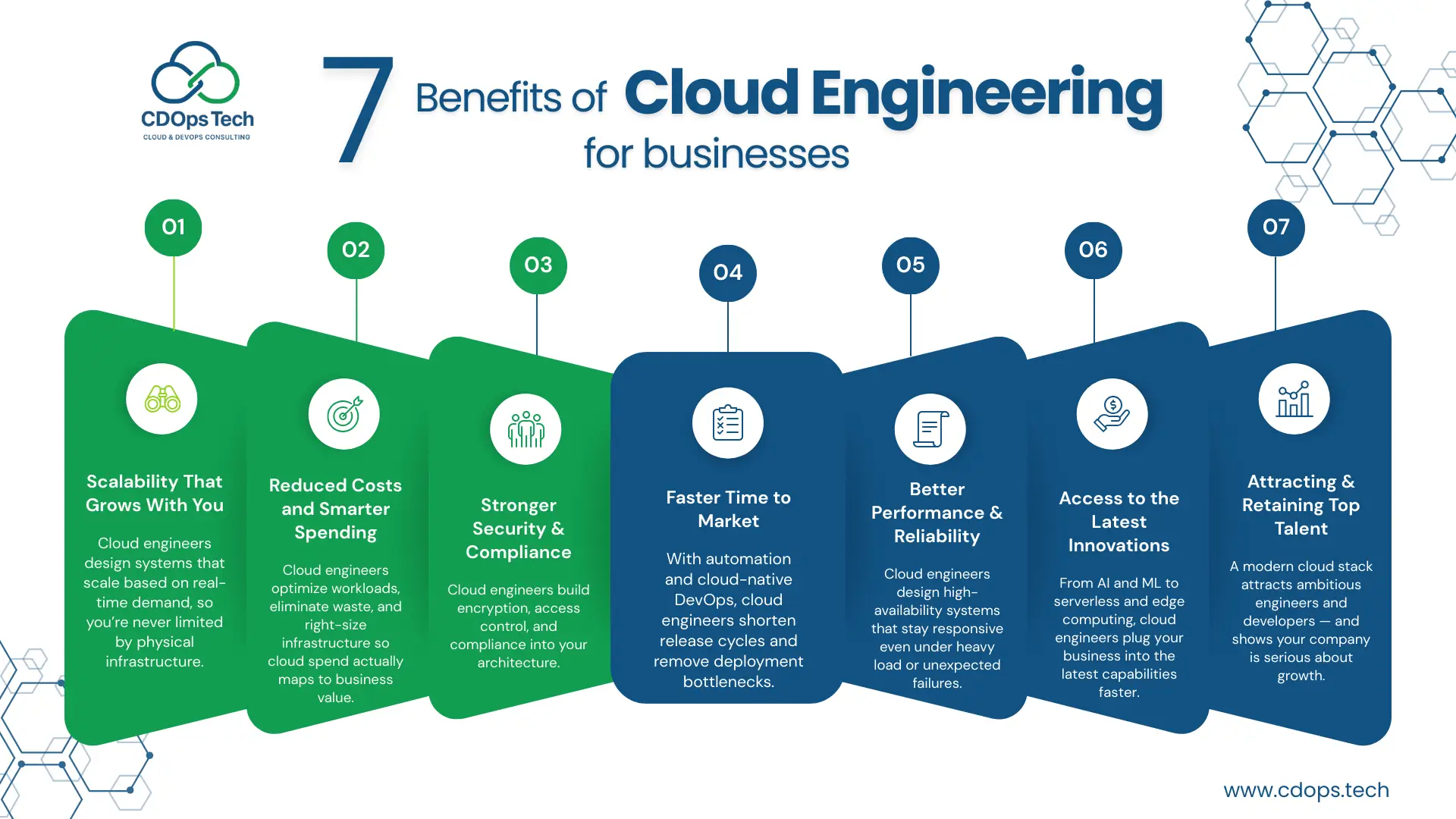
1. Scalability That Grows With You
Need to scale fast? That’s one of the biggest perks of the cloud. A cloud engineer can design systems that expand (or contract) based on real-time demand. Whether you’re running a cloud application that suddenly goes viral or expanding globally, cloud engineering ensures you’re not limited by physical infrastructure.
This flexibility is especially valuable in public cloud services, where you pay for what you use and nothing more.
2. Reduced Costs and Smarter Spending
Let’s talk about the bottom line.
While the salary for a cloud engineer might be significant, their impact on cost efficiency is often even bigger. By optimizing cloud environments, automating workloads, and eliminating wasteful resource use, cloud engineers help companies lower operating costs.
They also make informed decisions when selecting cloud service providers, ensuring that you’re using the right mix of services from platforms like AWS, Azure, or Google Cloud.
3. Stronger Security and Compliance
Security in the cloud isn’t automatic, it’s engineered.
One of the core responsibilities of a cloud engineer is ensuring the security of cloud systems, including data encryption, access control, and regulatory compliance. This is especially important for companies handling sensitive customer data or operating in regulated industries.
A good cloud engineer doesn’t just know how to build systems, they know how to protect them.
4. Faster Time to Market
Time is money, and cloud engineering speeds up both development and deployment.
Using cloud technologies, automation tools, and cloud computing services, engineers streamline DevOps workflows, remove bottlenecks, and reduce time-to-launch for products and features. That agility gives businesses a major edge in competitive markets.
5. Better Performance and Reliability
In today’s 24/7 digital world, downtime isn’t an option.
Cloud engineers are responsible for building resilient, high-availability systems that perform under pressure. With real-time monitoring, failover strategies, and distributed cloud infrastructure, businesses can maintain performance even during peak traffic or unexpected outages.
6. Access to the Latest Innovations
With the cloud, innovation is always within reach.
From AI and machine learning to edge computing and serverless architecture, cloud platforms evolve fast. Cloud engineers often use these emerging tools to build smarter, more powerful solutions for businesses.
This ability to tap into cutting-edge tech is one reason why the demand for cloud engineers continues to rise and why many professionals are choosing to become a cloud engineer.
7. Attracting Top Talent (and Retaining Them)
Believe it or not, having a solid cloud strategy can help attract the right people. Developers, analysts, and engineers want to work with modern stacks and scalable systems. Businesses that invest in strong cloud computing foundations signal that they’re forward-thinking and growth-ready.
Hiring skilled professionals, especially those with cloud engineering certifications, also helps ensure long-term stability and tech leadership.
Key Components of Cloud Engineering Solutions
Cloud engineering isn’t just about “moving stuff to the cloud.” It’s a complex, evolving field that blends software engineering, systems architecture, and IT operations – all focused on helping businesses unlock the full potential of cloud computing.
If you’re exploring a career as a cloud engineer, or you’re trying to understand the responsibilities of a cloud engineer, here are the key components that make up modern cloud engineering solutions:
1. Cloud Architecture
At the heart of it all is cloud architecture — the foundation of every cloud system. This includes designing scalable, secure, and cost-efficient environments using platforms like AWS, Microsoft Azure, or Google Cloud Platform.
A cloud engineer’s role here involves planning how applications, data, and services work together across different cloud infrastructure setups, including public cloud, private, hybrid, or multi-cloud models.
2. Cloud Migration
Many businesses still rely on outdated on-premise systems. Cloud engineers help re-architect these legacy platforms and guide companies through a cloud migration project, moving workloads, databases, and apps to more modern cloud environments.
It’s a high-impact part of a cloud engineer job, especially in organizations undergoing digital transformation.
3. Cloud Security
One of the most critical responsibilities of a cloud engineer is protecting sensitive data and ensuring the security of cloud systems.
From configuring firewalls and identity access controls to ensuring compliance with regulations, cloud security is non-negotiable. With so much at stake, companies seek cloud engineers who understand how to build secure cloud environments across various platforms.
4. Automation & DevOps Integration
A good cloud engineer knows that efficiency is everything. That’s why automation is baked into most cloud computing roles.
Using tools like Terraform, Ansible, or CI/CD pipelines, engineers automate the deployment, scaling, and monitoring of cloud services, reducing human error and speeding up delivery.
Many cloud engineers work closely with DevOps engineers, especially in fast-paced environments like startups or SaaS companies.
5. Cloud Networking & Data Management
Cloud engineers also manage cloud networks, cloud databases, and large volumes of cloud data, ensuring everything is accessible, optimized, and compliant.
Understanding how different cloud platforms handle networking, storage, and cloud database management is essential. This is where cloud engineering skills really come into play.
6. Cost Optimization
One of the overlooked but essential responsibilities of a cloud engineer is managing the budget. The best engineers know how to use cloud resources wisely, scaling up when needed and scaling down to save money.
Cloud engineers typically monitor usage, recommend architecture changes, and work with finance teams to ensure smart spending across cloud computing platforms.
Bonus: Certification & Career Growth
Want to become a cloud engineer? Start with a solid foundation in cloud fundamentals, then level up with certifications like:
- AWS Certified Solutions Architect
- Google Cloud Professional Cloud Engineer
- Microsoft Certified: Azure Administrator Associate
These cloud engineering certifications not only boost your knowledge but also your cloud engineer salary with many certified professionals earning well above the average salary for a cloud engineer.
When Do You Need Cloud Engineering Services?
Not every company needs a cloud engineer on day one, but most will need one eventually.
As your business grows and your digital footprint expands, cloud engineering services can become the difference between scaling efficiently and getting stuck in a tangle of outdated systems. So how do you know when it’s time to bring in a cloud engineer (or a whole team of them)?
Let’s break it down.
1. You're Outgrowing On-Premise Infrastructure
Still relying on physical servers in the office? That might’ve worked when you started, but today’s businesses need flexibility, scalability, and speed. A cloud engineer can help you shift from traditional systems to modern cloud infrastructure, whether it’s on a public cloud like AWS or a hybrid setup.
This transition, often referred to as cloud migration, is one of the most common reasons companies hire cloud engineers.
2. Your App or Platform Needs to Scale
If you’re preparing for growth, handling more users, or expanding to new markets, your tech needs to keep up.
Cloud engineers create systems that scale automatically, so you’re not scrambling during peak traffic. With experience across various cloud platforms, they know how to architect a system that performs reliably without blowing up your budget.
3. You Need Help Managing Multiple Cloud Services
Managing cloud services across different providers (like AWS, Azure, and Google Cloud) can get complicated fast. From configuring load balancers to securing storage buckets, every cloud provider has its own quirks.
Skilled cloud engineers must understand these nuances and know how to keep everything working together smoothly, especially in complex cloud environments.
4. You're Focused on Security and Compliance
Security isn’t a one-time project, it’s an ongoing process. A cloud engineer’s role often includes designing secure architectures, setting up identity access management (IAM), and ensuring data compliance with industry standards like GDPR, HIPAA, or SOC 2.
If your business handles sensitive data or operates in a regulated industry, the responsibilities of a cloud engineer become essential, not optional.
5. You Want to Optimize Costs and Performance
Cloud costs can spiral if you’re not paying attention. If you’re unsure what you’re being billed for, or worse, paying for things you don’t need, a good cloud engineer can step in to optimize resources, reduce waste, and ensure you’re getting the most value from your cloud platform account.
This ability to balance cost and performance is part of what makes the cloud engineer job so strategic for modern businesses.
6. You're Launching a New Product or Feature
Building something new? Whether it’s a mobile app, SaaS platform, or internal tool, cloud engineers help architect and deploy your product using the right cloud computing tools, setting you up for fast iteration and reliable performance.
They also work closely with developers and DevOps teams to automate deployments and streamline updates using cloud software and CI/CD pipelines.
7. You Need Specialized Cloud Engineering Skills
There are many types of cloud engineering roles, from cloud security engineers to cloud support specialists, and not every in-house team has that level of expertise.
When your project requires specific cloud platforms, technologies, or certifications, hiring or contracting a cloud engineer gives you access to skills you might not need full-time, but definitely need done right.
| Experience Level | Typical Responsibilities | Average Salary (USD) |
|---|---|---|
| Entry-Level Cloud Engineer | Assisting in basic cloud deployments, monitoring systems, learning platform-specific tools (e.g. AWS, Azure) | $85,000 – $100,000 |
| Mid-Level Cloud Engineer | Designing cloud solutions, managing infrastructure, optimizing performance, handling cloud security configurations | $105,000 – $130,000 |
| Senior Cloud Engineer | Leading cloud architecture, managing hybrid/multi-cloud, ensuring scalability and compliance, mentoring junior engineers | $135,000 – $160,000+ |
What Do Cloud Engineers Earn?
Let’s talk numbers.
As the demand for skilled cloud engineers continues to grow, so do the salaries. According to industry data, the average salary for a cloud engineer in the U.S. ranges from $115,000 to $160,000 annually, depending on experience, location, and certifications.
Entry-level professionals or cloud engineering students transitioning into the field can expect a starting salary for a cloud engineer around $90,000, while those with deep expertise in cloud, DevOps, or cloud security often command six figures and beyond.
Specialized cloud engineer roles like cloud security engineers, DevOps cloud engineers, or those managing public cloud services typically earn higher than average. Certifications from major cloud platforms such as AWS, Azure, or Google Cloud can also significantly boost your earning potential.
So whether you’re aiming to become a cloud engineer, hire one, or understand the ROI of building a cloud team, knowing what cloud engineer salaries look like helps you plan strategically.
Ready to Take the Next Step?
Whether you’re scaling your infrastructure, modernizing legacy systems, or looking to hire skilled cloud engineers, CDOps Tech is here to help.
Our team brings deep experience with cloud platforms such as AWS, Google Cloud, and Azure, and we understand the unique challenges of managing cloud services in fast-moving, high-growth environments.
From optimizing cloud infrastructure to navigating the responsibilities of a cloud engineer, we support businesses at every stage of their cloud computing journey.
Need help with selecting the right cloud engineer roles, building a secure architecture, or figuring out what the average salary for a cloud engineer means for your budget? Contact CDOps Tech today and get the expert support you need to build smart, scale fast, and thrive in the cloud.