Everyone loves talking about AI like it’s a strategy.
It’s not. It’s a cost center until proven otherwise.
The moment you choose between deep learning vs machine learning, you’re not picking a buzzword. You’re choosing:
- Infrastructure complexity
- Hiring difficulty
- Time-to-production
- And how many sleepless nights your team will have
Here’s the part most blogs skip:
The wrong AI decision doesn’t fail loudly. It drains budget quietly.
A machine learning model might get you to production in weeks. A deep learning model, especially one built on deep neural networks, can take months of tuning, retraining, and infrastructure scaling.
And yet, teams keep defaulting to deep learning because it sounds more advanced.
Reality check (with data):
- 80–90% of AI models never make it to production, according to Gartner
- Training large deep learning algorithms can cost 10–100x more than traditional ML approaches (OpenAI estimates on compute scaling)
- Poor AI implementation costs businesses millions in wasted cloud spend annually (McKinsey Technology reports on AI adoption inefficiencies)
So no, this isn’t about what’s “better.”
It’s about what won’t break your system, your team, or your budget.
AI in Practice (Not Theory)
Let’s strip the hype.
Artificial intelligence isn’t magic. It’s systems that:
- Learn from training data
- Detect patterns across data points
- Make decisions without being explicitly programmed
That’s it.
Inside this world of artificial intelligence, you’ll find:
- Machine learning and deep learning
- Different learning algorithms (supervised learning, unsupervised learning, reinforcement learning)
- A messy stack of tools pretending to be simple
Here’s the key:
- Machine learning is a subset of AI. Deep learning is a subset of machine learning.
Or more bluntly:
- AI is the umbrella
- ML is the practical engine
- DL is the high-powered, high-maintenance version
Most real-world AI applications, fraud detection, recommendation systems, forecasting, don’t need bleeding-edge models. They need:
- Clean structured data
- Reliable pipelines
- Models that actually ship
And yet, teams jump straight to deep learning vs simpler approaches.
Why?
Because “neural network” sounds smarter than “logistic regression.”
It’s branding, not engineering.
Machine Learning vs Deep Learning
Let’s settle the machine learning vs deep learning debate quickly, without turning this into a lecture.
Machine Learning
A machine learning algorithm:
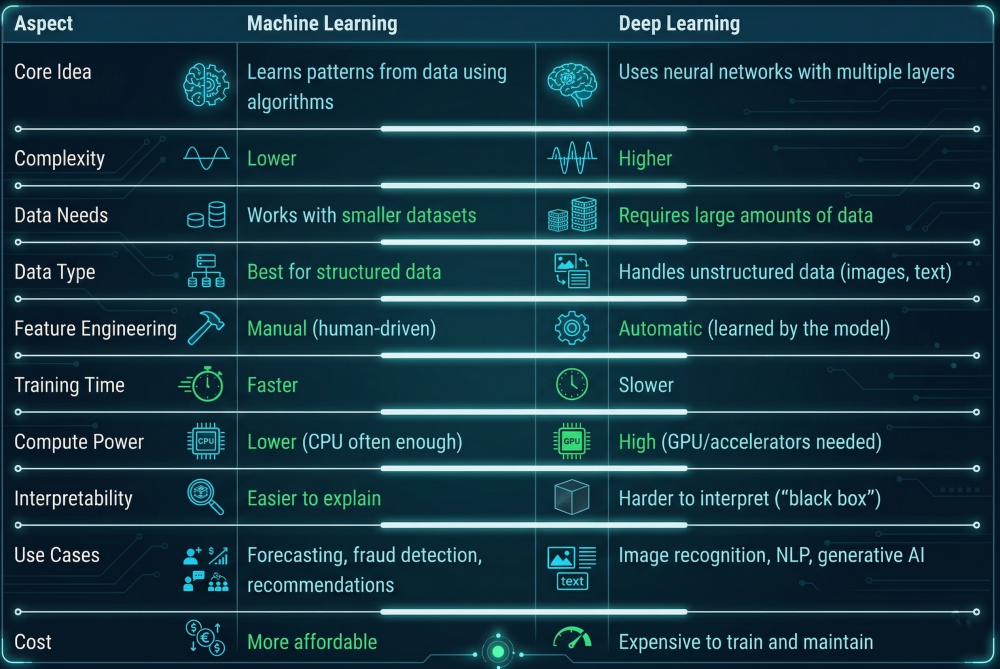
- Learns patterns from structured data
- Often relies on feature engineering (humans define what matters)
- Works well with smaller datasets
- Includes methods like:
- Supervised learning
- Unsupervised learning
- Reinforcement learning
In practice:
- Faster to train
- Easier to debug
- Requires more human intervention upfront
- Think: predicting churn, pricing models, fraud detection.
Deep Learning
Deep learning is a subset of machine learning that uses artificial neural networks—specifically multi-layered artificial neural networks (aka deep neural networks).
These include:
- Convolutional neural networks (CNNs) → image recognition
- Recurrent neural networks (RNNs) → sequential data
- Generative adversarial networks (GANs) → generative AI
A deep learning model:
- Learns directly from raw data
- Handles unstructured data like images, audio, and text
- Uses multiple hidden layers within the neural network
In practice:
- Less manual feature engineering
- Much higher compute requirements
- Longer training cycles
In practice:
- Less manual feature engineering
- Much higher compute requirements
- Longer training cycles
- Think: natural language processing, computer vision, generative AI.
The Real Difference Between Machine Learning and Deep Learning
Now let’s get to what actually matters.
Not definitions, the difference between machine learning and difference between deep learning in the real world.
a) Data Requirements
- Machine learning works with smaller, cleaner datasets
- Deep learning depends on massive volumes of training data
Why?
Because deep learning algorithms use layered representations to learn features automatically. Without enough data, those layers don’t learn anything useful.
- No data = no intelligence.
b) Infrastructure & Cost
This is where most teams get blindsided.
- Machine learning models → CPU-friendly, cheaper
- Deep learning models → GPU/accelerator-heavy
A single deep learning model requires:
- Specialized hardware
- Distributed training
- Ongoing optimization
That’s not a model problem.
That’s a DevOps problem.
c) Development Speed
- ML = faster experimentation cycles
- DL = slower, more complex iteration
With ML:
- You tweak features
- Retrain quickly
- Ship faster
With DL:
- You adjust architectures
- Retrain massive models
- Wait… a lot
d) Maintenance & Scaling
Here’s the part nobody advertises.
- ML models → easier monitoring, simpler pipelines
- DL models → harder to debug, harder to explain
Inside a neural network, decisions happen across layers you can’t easily interpret.
That’s fine, until something breaks.
Hunt Down Your Cloud Zombies
Unused resources draining your budget? Find and eliminate waste fast.
When to Use Machine Learning (and When Not To)
Here’s the unpopular truth:
Most companies should use machine learning, and stop there.
Not because it’s “simpler.”
Because it’s sufficient.
A solid machine learning approach can handle the majority of real-world AI applications:
- Fraud detection
- Demand forecasting
- Recommendation systems
- Customer segmentation
This is the part where machine learning can help without dragging you into unnecessary complexity.
Use machine learning when:
- Your data is mostly structured
- You have limited training data
- You need fast deployment
Interpretability matters (you need to explain decisions) - You’re early in your data science maturity
This is where classic ml algorithms, a type of machine learning, shine:
- Regression models
- Tree-based models
- Clustering techniques
They rely on a clear learning process and often benefit from human-guided improvements.
Yes, that means human intelligence still plays a role.
And that’s not a weakness. That’s control.
Don’t use machine learning when:
- You’re dealing with complex perception problems
- Your data is highly unstructured
- You’re trying to mimic human-like understanding
That’s where the conversation shifts toward deep learning vs traditional ML.
But here’s the catch:
Just because you can use deep learning doesn’t mean you should.
When to Use Deep Learning (and When It’s Overkill)
Deep learning has a reputation problem.
It’s seen as the “next level” of artificial intelligence.
In reality:
Deep learning is a specialized subset of machine learning, not a universal upgrade.
It works brilliantly in specific use cases, especially where traditional ML breaks down.
Use deep learning when:
- You’re working with unstructured data (images, audio, text)
- You need high accuracy at scale
- You have massive datasets
- You can support infrastructure for deep neural networks
This is where systems that use artificial neural networks, like:
- Feedforward neural networks
- Convolution-based architectures
- Advanced AI models
start to outperform traditional approaches.
You’ll also see techniques like:
- Transfer learning (reusing pre-trained models)
- Semi-supervised learning (less labeled data, more flexibility)
This is modern AI and machine learning at its most powerful.
Don’t use deep learning when:
- You don’t have enough data
- You need fast iteration
- Your team lacks MLOps maturity
- A simpler model gets you “good enough” results
Because here’s the truth:
Many teams jump into deep learning vs machine learning, and end up solving the wrong problem, expensively.
The Hidden Bottleneck: It’s Not the Model
Most discussions about deep learning and machine learning focus on:
- Algorithms
- Architectures
- Accuracy
But that’s not where projects fail.
They fail in the learning process around them.
The real bottlenecks:
- Poor data pipelines
- Weak deployment workflows
- Lack of monitoring for AI models
- No feedback loop after deployment
In other words:
The problem isn’t the model. It’s everything around the model.
This is where the gap between theory and practical learning becomes obvious.
You can have:
- The best neural network
- The most advanced AI tools
- A cutting-edge deep learning model
And still fail to deliver value.
Why?
Because achieving AI in production requires more than a model:
- Reliable infrastructure
- Scalable systems
- Continuous optimization
This is the part most teams underestimate in the field of artificial intelligence.
Feature Engineering vs Neural Networks
This is where the philosophical divide shows up.
Not just in technology, but in how you think about problem-solving.
Machine Learning: Feature Engineering First
Traditional machine learning and deep learning differ heavily here.
In ML:
- You define the inputs
- You guide the model
- You shape the outcome
This process feature engineering means:
- Selecting relevant variables
- Transforming raw data into usable signals
- Injecting domain knowledge into the system
It’s hands-on.
It’s controlled.
And yes, it requires more human intelligence.
Deep Learning: Let the Neural Network Learn
Deep learning flips that.
Instead of manual features, it uses layers within the neural network to learn representations automatically.
A system built on a neural network:
- Learns patterns directly from raw inputs
- Uses multiple hidden layers
- Reduces the need for manual intervention
This is why deep learning uses complex architectures:
- Multi-layered systems
- Hierarchical feature extraction
- End-to-end learning techniques
A Practical Decision Framework
Let’s stop debating theory and make a decision.
Because the real question isn’t:
What’s the difference between deep learning and machine learning?
It’s:
Which one should we actually use?
Here’s a practical learning framework you can apply immediately, no PhD required.
1. Data Size & Type
- Mostly structured, limited data → Machine learning wins
- Large volumes of unstructured data → Deep learning wins
2. Time to Deploy
- Need results fast → go with ML
- Can afford long experimentation cycles → consider DL
Most teams underestimate how long using deep neural networks actually takes.
3. Budget & Infrastructure
- Limited budget → ML
- Willing to invest in GPUs, scaling, and optimization → DL
This is where the primary difference between machine learning approaches becomes painfully obvious.
4. Problem Complexity
- Predictive tasks → ML (pricing, churn, forecasting)
- Perception tasks → DL (vision, speech, NLP)
If the task would normally require human intelligence, deep learning might make sense.
5. Team & Maturity
- Early-stage team → ML
- Mature AI/DevOps stack → DL
Because deep learning is a specialized subset of machine learning, it demands more than just data scientists, it needs infrastructure, monitoring, and discipline.
Can Your DevOps Handle AI?
The Truth About AI Adoption
Here’s the part most companies don’t want to hear.
The biggest mistake in deep learning vs machine learning isn’t choosing the wrong model.
It’s choosing AI at all, for the wrong reasons.
The reality of AI adoption
- Many teams use AI because competitors do
- Not because the problem actually requires it
- Or because simpler systems already work
The result?
- Overengineered systems
- Underutilized models
- Expensive infrastructure nobody fully understands
What’s actually happening behind the scenes
The evolution of machine learning has made tools more accessible, but not easier to use correctly.
There are now multiple types of AI:
- Rule-based systems
- Traditional ML (a branch of machine learning)
- Deep learning (a specialized subset of machine learning)
But accessibility created a new problem:
People can build models faster than they can justify them.
The brutal takeaway
Most companies don’t need deep learning.
Many don’t even need machine learning.
They need:
- Better data
- Better processes
- Better decision-making
Because real artificial intelligence isn’t about models.
It’s about outcomes.
What This Means for AI Systems in the Real World
In the world of artificial intelligence, success doesn’t come from picking the most advanced approach.
It comes from aligning:
- Problem
- Data
- Infrastructure
- Team capability
The difference that actually matters
The difference between machine learning and difference between deep learning isn’t just technical.
It’s operational.
- Machine learning → easier to deploy, easier to maintain
- Deep learning → harder to scale, harder to control
And that’s why the machine learning vs deep learning decision is really a business decision.
Not a data science one.
Where most teams go wrong
They ask:
What’s the difference between deep learning models and ML models?
Instead of:
What’s the simplest system that solves our problem?
A smarter way to think about it
- Use ML when you want reliable, fast, explainable systems
- Use DL when you truly need advanced capabilities powered by systems that use artificial neural networks
And even then, start small.
Because even the most advanced system, often called an artificial neural network, is useless if it never reaches production.
Still Debating Deep Learning vs Machine Learning?
At CDOps Tech, we don’t just explain AI, we help you run it in production.
Whether you’re:
- Deciding between machine learning vs deep learning
- Struggling with infrastructure for a neural network
- Or trying to turn AI experiments into real systems
We’ll help you:
- Choose the right approach (not the trendiest one)
- Build scalable, cost-efficient AI systems
- Avoid expensive mistakes before they happen
Still unsure what’s right for your use case? Let’s talk.