Modern software teams are under pressure to release features faster than ever. At the same time, security threats continue to evolve, compliance requirements are becoming stricter, and software supply chain attacks are increasing in both frequency and impact.
This creates a difficult challenge: how do you maintain development speed without introducing security risks That’s where DevSecOps comes in.
DevSecOps integrates security into every stage of the software development lifecycle rather than treating it as a final review before deployment. By embedding security controls, automated security testing, and secure development practices directly into the development pipeline, organizations can reduce vulnerabilities while maintaining delivery velocity.
In this guide, we’ll explore 10 DevSecOps best practices that help engineering teams automate security, improve compliance, strengthen application security, and build more resilient software delivery processes.
What Is DevSecOps?
DevSecOps is a software development approach that integrates security into DevOps workflows from the earliest stages of development through deployment and ongoing operations.
Traditionally, development teams built applications, operations teams deployed them, and security teams reviewed them near the end of the release cycle. This often created bottlenecks, delayed releases, and allowed security vulnerabilities to reach production.
DevSecOps changes this model by making security a shared responsibility across development, operations, and security teams.
DevSecOps explained
The term DevSecOps combines three disciplines:
| Function | Primary Goal | Role in DevSecOps |
|---|---|---|
| Development | Build software quickly | Create secure code and follow secure coding practices |
| Security | Protect systems and data | Define security controls, policies, and testing requirements |
| Operations | Maintain reliability | Deploy secure infrastructure and monitor threats |
Rather than adding security at the end of the development process, DevSecOps aims to embed security throughout the development lifecycle.
This includes:
- Automated security testing
- Vulnerability scanning
- Secure code reviews
- Threat modeling
- Compliance validation
- Software supply chain protection
- Continuous monitoring
DevOps vs DevSecOps
Both DevOps and DevSecOps focus on improving software delivery through collaboration and automation. The key difference is that DevSecOps integrates security directly into the workflow.
| Area | DevOps | DevSecOps |
|---|---|---|
| Primary Focus | Speed and delivery | Speed, delivery, and security |
| Security Reviews | Often performed later | Integrated into every stage |
| Testing | Functional and performance testing | Functional, performance, and security testing |
| Ownership | Development and operations | Development, operations, and security |
| Risk Management | Limited security focus | Continuous security management |
Principles of DevSecOps
Successful DevSecOps programs typically follow several core principles:
1. Shift security left
Security should be introduced as early as possible during software development. Identifying vulnerabilities during design or coding is significantly less expensive than fixing them after deployment.
2. Automate wherever possible
Automation helps teams perform security checks consistently without slowing down delivery.
4. Make security everyone’s responsibility
Developers, operations teams, and security teams should work together rather than operating in isolated silos.
5. Continuously monitor risks
Security doesn’t end after deployment. Organizations must continuously monitor applications, infrastructure, and user activity for emerging threats.
Benefits of DevSecOps
Organizations adopting DevSecOps often see improvements across both security and software delivery performance.
According to the 2024 State of DevOps Report by Google Cloud, organizations with mature DevOps and security practices are more likely to achieve faster deployment frequency and lower change failure rates.
Some of the most significant benefits of DevSecOps include:
- Faster software delivery
- Earlier detection of security vulnerabilities
- Reduced remediation costs
- Improved compliance readiness
- Better collaboration between teams
- Stronger software supply chain security
- Improved security posture
Why DevSecOps Best Practices Matter
Adopting DevSecOps is no longer just a security initiative. It has become a business requirement for organizations that rely on rapid software development and continuous deployment.
As software ecosystems become more complex, organizations face increasing pressure to manage security risks without slowing innovation.
Security threats are growing faster than release cycles
Modern applications depend on:
- Open-source packages
- APIs
- Containers
- Cloud services
- Third-party integrations
Every dependency introduces potential security vulnerabilities into the development pipeline.
Attackers increasingly target software supply chains because a single compromised dependency can affect thousands of organizations.
The 2024 Verizon Data Breach Investigations Report found that exploitation of vulnerabilities remains one of the most common attack vectors across industries.
Finding vulnerabilities late is expensive
One of the biggest reasons organizations embrace DevSecOps practices is cost reduction.
Research from the National Institute of Standards and Technology (NIST) has consistently shown that fixing defects after deployment costs significantly more than resolving them during development.
The longer a vulnerability remains undiscovered, the more expensive remediation becomes.
Security and compliance can no longer be separated
Compliance requirements such as:
- SOC 2
- ISO 27001
- PCI DSS
- HIPAA
- GDPR
increasingly require organizations to demonstrate repeatable security controls and continuous monitoring.
Manual processes often struggle to keep pace with these requirements.
By integrating security controls directly into the DevSecOps pipeline, teams can automate evidence collection, policy enforcement, and audit preparation.
Common consequences of poor DevSecOps adoption
Organizations that fail to integrate security throughout the development cycle often experience:
| Challenge | Potential Impact |
|---|---|
| Delayed vulnerability discovery | Expensive remediation efforts |
| Manual security reviews | Slower deployments |
| Inconsistent security policies | Compliance failures |
| Lack of visibility | Increased security risks |
| Weak software supply controls | Supply chain attacks |
10 DevSecOps Best Practices Every Engineering Team Should Follow
Implementing DevSecOps successfully requires more than deploying security tools. The most effective organizations combine people, processes, automation, and governance to create a sustainable security program.
The following best DevSecOps practices help organizations improve security without sacrificing development speed.
1. Shift security left from the beginning
The shift security left approach moves security activities earlier in the software development life cycle. Instead of waiting until deployment, security considerations are introduced during planning, architecture reviews, and coding.
According to the U.S. National Institute of Standards and Technology (NIST), identifying and addressing security issues earlier in the development lifecycle can significantly reduce remediation costs and improve software quality. Organizations can align these efforts with the NIST Secure Software Development Framework (SSDF)
Teams should:
- Define security requirements during project planning
- Conduct architecture risk reviews
- Train developers on secure coding practices
- Use automated security checks during development
Quick implementation checklist
- Include security requirements in user stories
- Review architecture diagrams before development starts
- Run security scans on every code commit
- Establish security acceptance criteria before deployment
This approach reduces rework and helps identify potential security issues before they become expensive production problems.
2. Automate security testing throughout the pipeline
Manual security testing cannot keep pace with modern software delivery. Organizations should automate security testing throughout the DevSecOps pipeline using:
- Static Application Security Testing (SAST)
- Dynamic Application Security Testing (DAST)
- Software Composition Analysis (SCA)
- Container security scanning
- Infrastructure-as-Code scanning
The Open Worldwide Application Security Project (OWASP) recommends integrating automated security testing throughout the software development lifecycle to identify vulnerabilities before production.
What should be automated first?
| Priority | Security Testing Type | Purpose |
|---|---|---|
| High | SAST | Detect coding flaws early |
| High | SCA | Identify vulnerable dependencies |
| Medium | Secrets Scanning | Prevent credential exposure |
| Medium | IaC Scanning | Detect cloud misconfigurations |
| Medium | DAST | Test running applications |
Automated security testing allows teams to detect vulnerabilities continuously while maintaining release velocity.
3. Integrate security controls into CI/CD workflows
Security controls should be embedded directly into the development workflow.
Examples include:
- Secrets scanning
- Dependency validation
- Security policy enforcement
- Container image verification
- Build integrity checks
Integrating security into CI/CD pipelines ensures that vulnerabilities are identified before software reaches production environments.
4. Perform continuous threat modeling
Threat modeling helps teams identify potential attack paths before implementation begins.
Engineering teams should perform threat modeling:
- During architecture design
- Before major releases
- When introducing new services
- After significant infrastructure changes
Frameworks such as STRIDE and MITRE ATT&CK can help standardize analysis. MITRE ATT&CK provides one of the most widely adopted knowledge bases for understanding adversary behavior and attack techniques.
Questions every threat model should answer
- What are we building?
- What can go wrong?
- What security controls are in place?
- What additional mitigations are needed?
- How will risks be monitored after deployment?
5. Secure the software supply chain
Software supply chain security has become a major focus area for security leaders.
Following the 2021 Executive Order on Improving the Nation’s Cybersecurity, software transparency and Software Bills of Materials (SBOMs) have become increasingly important. The Cybersecurity and Infrastructure Security Agency (CISA) provides guidance on SBOM adoption and software supply chain security.
Organizations should:
- Maintain a Software Bill of Materials (SBOM)
- Monitor third-party dependencies
- Verify package authenticity
- Restrict untrusted repositories
- Continuously scan open-source components
Supply chain security controls
| Control | Purpose |
|---|---|
| SBOM | Software component visibility |
| Dependency scanning | Identify vulnerable packages |
| Code signing | Verify software integrity |
| Provenance validation | Confirm software origins |
| Repository controls | Prevent unauthorized packages |
These controls reduce exposure to supply chain attacks and vulnerable dependencies.
6. Enforce secure coding standards
Secure code is the foundation of effective DevSecOps.
Development teams should align coding standards with the OWASP Secure Coding Practices Quick Reference Guide, which provides practical recommendations for building secure applications.
Key areas include:
- Input validation
- Authentication controls
- Authorization mechanisms
- Encryption practices
- Secrets management
Common secure coding mistakes
- Hardcoded credentials
- Missing input validation
- Insecure API endpoints
- Weak authentication logic
- Insufficient logging
Consistent code review processes further improve application security.
7. Continuously monitor security vulnerabilities
Security monitoring should continue after deployment.
Organizations should monitor:
- Application logs
- Infrastructure events
- User activity
- Container workloads
- Cloud resources
Continuous visibility helps identify emerging threats and security vulnerabilities before attackers can exploit them.
8. Strengthen identity and access management
Poor access controls remain a leading cause of security incidents.
Teams should implement:
- Least-privilege access
- Multi-factor authentication
- Role-based access controls
- Secret rotation policies
- Privileged account monitoring
These measures help reduce unauthorized access and insider threats.
9. Build compliance into development processes
Compliance should be automated rather than handled manually.
Organizations can integrate security and compliance checks directly into the development pipeline through:
- Compliance-as-Code
- Automated evidence collection
- Policy validation
- Continuous audit readiness checks
For organizations handling regulated data, frameworks such as NIST Cybersecurity Framework, PCI DSS,, and ISO 27001 can help establish consistent security controls and governance requirements.
Compliance activities that can be automated
- Security policy validation
- Access reviews
- Audit evidence collection
Infrastructure compliance checks - Configuration monitoring
This reduces administrative overhead while improving consistency.
10. Build a strong DevSecOps culture
Technology alone cannot create successful DevSecOps adoption.
Organizations should encourage:
- Shared ownership of security
- Security champion programs
- Ongoing developer education
- Collaboration between development and security teams
- Continuous improvement initiatives
A strong DevSecOps culture ensures security becomes part of everyday development practices rather than an afterthought.
From Reactive Security to Continuous DevSecOps
A simple five-step path for integrating security into your DevOps pipeline without slowing delivery.
Assess current security maturity
Review tools, workflows, vulnerabilities, compliance gaps, and ownership.
Prioritize high-risk areas
Start with exposed systems, critical apps, weak access controls, and risky dependencies.
Automate security controls
Add SAST, SCA, secrets scanning, container checks, and policy validation.
Scale across teams
Standardize practices, train developers, define ownership, and repeat what works.
Measure and improve
Track MTTR, vulnerability backlog, deployment quality, and compliance readiness.
Many organizations understand the benefits of DevSecOps but struggle with where to begin. A phased implementation approach helps teams improve security without disrupting existing workflows.
Phase 1: Assess current security maturity
Start by evaluating your existing:
- Development practices
- Security tools
- Compliance requirements
- Security controls
- Software delivery processes
Identify security gaps and prioritize the highest-risk areas first.
Phase 2: Establish baseline security controls
Implement foundational capabilities such as:
- Secure coding standards
- Vulnerability scanning
- Identity management controls
- Security policies
- Logging and monitoring
Focus on consistency before expanding automation.
Phase 3: Integrate security into the DevOps pipeline
Embed security checks directly into the development workflow.
This often includes:
- SAST tools
- DAST tools
- Software composition analysis
- Secrets detection
- Infrastructure scanning
The goal is to automate security without slowing deployments.
Phase 4: Expand automation and governance
As teams mature, increase automation across:
- Compliance validation
- Security testing
- Threat detection
- Policy enforcement
- Reporting
This stage helps improve scalability and operational efficiency.
Phase 5: Optimize and continuously improve
DevSecOps is an ongoing process rather than a one-time project.
Track metrics such as:
| Metric | Why It Matters |
|---|---|
| Mean Time to Detect (MTTD) | Measures threat visibility |
| Mean Time to Remediate (MTTR) | Measures response efficiency |
| Vulnerability remediation rate | Tracks security improvements |
| Deployment frequency | Measures delivery performance |
| Change failure rate | Evaluates release quality |
Organizations that continuously refine their DevSecOps framework are better positioned to adapt to evolving threats, maintain compliance, and deliver secure software at scale.
Build a more secure delivery pipeline
Recommended Security Tools for DevSecOps
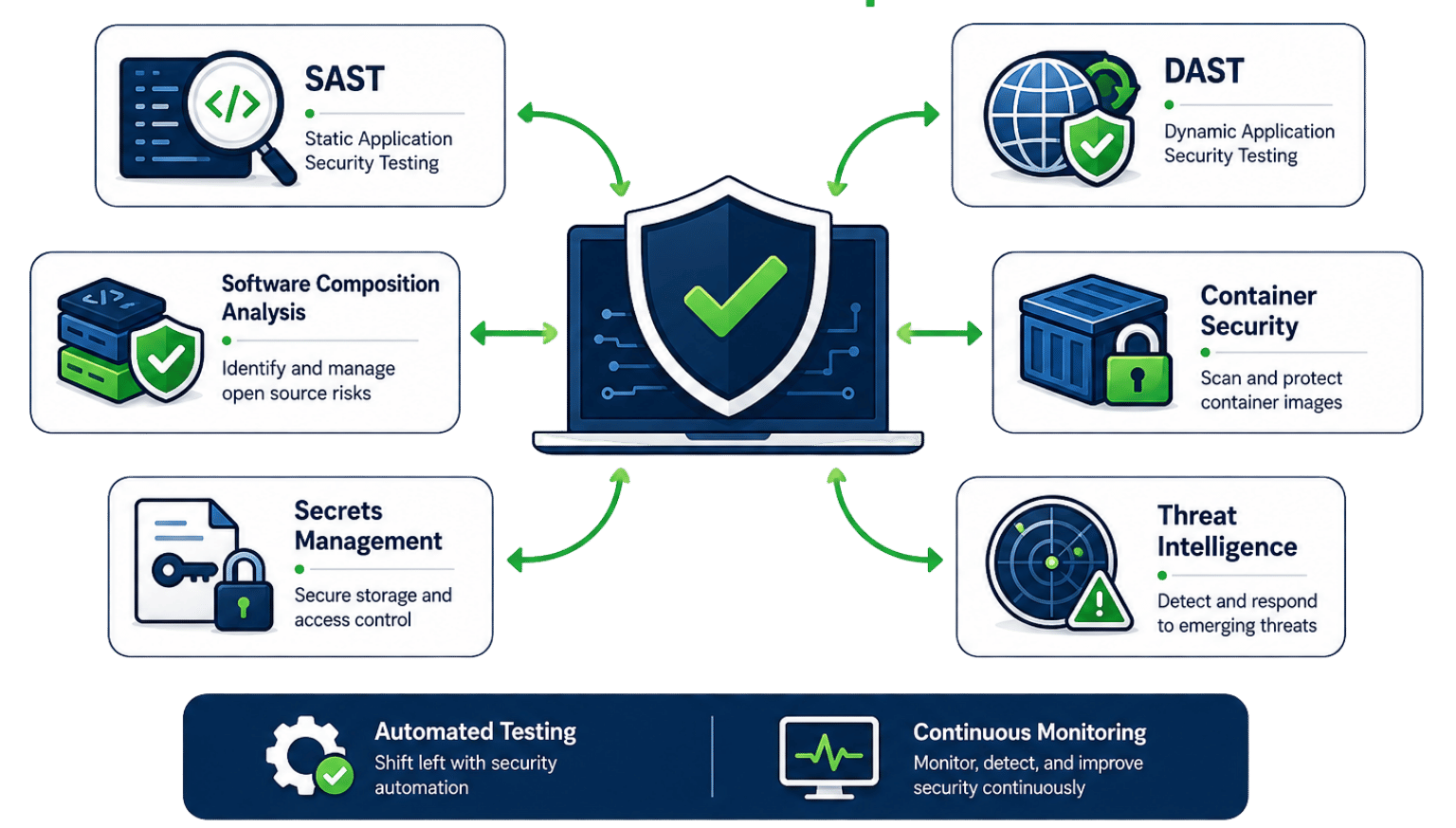
The right tools can help teams automate security, improve visibility, and enforce security controls throughout the software development lifecycle. However, successful DevSecOps is not about having the largest security stack. It’s about selecting tools that integrate seamlessly into existing workflows and support your DevSecOps process.
Rather than focusing on specific vendors, it’s often more useful to evaluate tool categories based on your organization’s maturity, risk profile, and deployment requirements.
Code security tools
Code security tools help identify vulnerabilities before software reaches production.
Common categories include:
- Static Application Security Testing (SAST)
- Software Composition Analysis (SCA)
- Secrets detection
- Secure code review platforms
Organizations following DevSecOps best practices often combine SAST and SCA tools to identify both coding flaws and vulnerable dependencies.
Cloud and infrastructure security tools
As organizations increasingly deploy applications in cloud environments, infrastructure security becomes a critical component of the DevSecOps pipeline.
Security tools in this category include:
- Infrastructure-as-Code scanners
- Cloud Security Posture Management (CSPM) platforms
- Configuration auditing tools
- Kubernetes security solutions
These tools help identify misconfigurations that could create potential security risks.
Container and software supply chain security tools
Containers and third-party dependencies introduce additional attack surfaces.
Organizations should consider automated tools that support:
- Container image scanning
- SBOM generation
- Dependency monitoring
- Artifact signing
- Provenance verification
Compliance and governance tools
Compliance automation tools help reduce manual effort while improving audit readiness.
Typical capabilities include:
- Policy-as-Code
- Continuous compliance monitoring
- Automated evidence collection
- Security controls validation
These solutions can simplify alignment with frameworks such as NIST, PCI DSS, SOC 2, ISO 27001, and HIPAA.
What should teams prioritize first?
For organizations implementing DevSecOps best practices, the following sequence often delivers the fastest value:
| Priority | Tool Category | Primary Goal |
|---|---|---|
| 1 | SAST | Detect coding vulnerabilities |
| 2 | SCA | Identify vulnerable dependencies |
| 3 | Secrets Scanning | Prevent credential exposure |
| 4 | IaC Security | Secure cloud infrastructure |
| 5 | Container Security | Protect runtime environments |
| 6 | Compliance Automation | Streamline governance |
Common DevSecOps Mistakes That Slow Teams Down
Even organizations with strong security intentions can struggle when implementing DevSecOps. In many cases, the biggest obstacles are not technical limitations but process and cultural challenges.
Avoiding the following mistakes can accelerate DevSecOps adoption and improve long-term results.
Treating security as someone else’s job
One of the most common misconceptions is believing that security belongs exclusively to security teams.
DevSecOps means security becomes a shared responsibility across development, operations, and security stakeholders.
When developers are disconnected from security outcomes, vulnerabilities often remain unresolved until late in the development cycle.
Instead:
- Establish shared ownership
- Define security responsibilities clearly
- Create security champion programs
Encourage collaboration between development and security teams
Prioritizing tools over processes
Many organizations purchase new security tools before defining workflows or security principles.
Tools can automate tasks, but they cannot replace a well-defined DevSecOps framework.
Before investing in new platforms, establish:
- Security policies
- Risk management processes
- Secure coding standards
- Incident response procedures
- Compliance requirements
Effective DevSecOps combines tools and processes rather than relying solely on technology.
Generating too many alerts
Security teams often deploy multiple scanners that generate thousands of findings.
Without proper prioritization, developers become overwhelmed and begin ignoring alerts.
To avoid alert fatigue:
- Focus on high-risk vulnerabilities first
- Prioritize exploitable issues
- Align findings with business risk
- Automate triage where possible
The goal is to improve security, not create noise.
Delaying threat modeling
Threat modeling is frequently skipped because teams view it as time-consuming.
However, identifying attack paths early often saves significant effort later.
Organizations following DevSecOps best practices typically perform threat modeling during:
- Architecture reviews
- New feature planning
- Cloud migrations
- Major application changes
Security practices earlier in the development lifecycle often produce better outcomes than reactive remediation.
Ignoring software supply chain security
Many teams focus heavily on application code while overlooking third-party components.
Recent supply chain attacks demonstrate why dependency management must be part of every DevSecOps strategy.
Organizations should continuously monitor:
- Open-source libraries
- Container images
- Build pipelines
- Package repositories
- Software provenance
Measuring vulnerability counts instead of risk
A high vulnerability count does not always indicate high risk.
Some findings may be low impact, while a single critical flaw could expose sensitive systems.
A more effective approach is measuring:
- Exploitability
- Business impact
- Remediation speed
- Exposure level
This creates a more accurate picture of overall security posture.
Common DevSecOps mistakes at a glance
| Mistake | Impact | Better Approach |
|---|---|---|
| Security owned by one team | Slow remediation | Shared responsibility |
| Tool-first strategy | Poor adoption | Process-first approach |
| Excessive alerts | Alert fatigue | Risk-based prioritization |
| No threat modeling | Hidden risks | Continuous threat analysis |
| Weak dependency management | Supply chain exposure | Continuous monitoring |
| Counting vulnerabilities only | Misleading metrics | Risk-focused measurement |
How to Measure DevSecOps Success
Implementing DevSecOps is only the first step. To understand whether your efforts are working, you need meaningful metrics that connect security activities to business outcomes.
The most successful organizations measure security, operational performance, and software delivery together.
Security metrics
Security metrics help teams evaluate how effectively they identify and remediate vulnerabilities.
Common metrics include:
- Mean Time to Detect (MTTD)
- Mean Time to Remediate (MTTR)
- Critical vulnerability backlog
- Vulnerability recurrence rate
- Security incident frequency
According to the NIST Cybersecurity Framework, continuous measurement is essential for maintaining and improving cybersecurity.
Software delivery metrics
DevSecOps should improve security without significantly reducing development velocity.
Key software delivery metrics include:
- Deployment frequency
- Lead time for changes
- Change failure rate
- Release success rate
- Recovery time after incidents
Tracking these indicators helps ensure that security controls support, rather than hinder, software delivery.
Compliance metrics
Organizations operating in regulated industries should monitor compliance-related performance.
- Useful metrics include:
- Audit findings
- Compliance exceptions
- Policy violations
- Evidence collection completion rates
- Control coverage
These measurements provide visibility into governance effectiveness.
Business metrics
Executive stakeholders often care less about technical findings and more about business impact.
Consider tracking:
- Security-related downtime
- Cost of incidents
- Remediation costs
- Customer trust indicators
- Audit preparation time
These metrics demonstrate the benefits of DevSecOps in terms business leaders understand.
Key DevSecOps metrics to track
| Category | Metric | Why It Matters |
|---|---|---|
| Security | MTTD | Measures detection effectiveness |
| Security | MTTR | Measures remediation efficiency |
| Security | Critical vulnerability backlog | Indicates risk exposure |
| Delivery | Deployment frequency | Measures release velocity |
| Delivery | Change failure rate | Measures release quality |
| Compliance | Audit findings | Tracks governance performance |
| Business | Incident cost | Measures financial impact |
Ready To Strengthen Your DevSecOps Strategy?
The key DevSecOps takeaway is simple, security works best when it becomes part of everyday development and operations rather than a separate activity performed before deployment.
Whether you’re adopting DevSecOps for the first time or refining an existing DevSecOps framework, success depends on consistently following DevSecOps best practices, aligning security principles with business goals, and continuously improving your tools and processes.
If your organization needs help implementing DevSecOps best practices, strengthening CI/CD security, improving compliance readiness, or building a scalable security strategy, the team at CDops Tech can help.
Contact us to discuss your goals and discover how implementing DevSecOps best practices can help your development teams deliver secure, reliable software faster.