
The Right SRE Support for Your Critical Services
For companies experiencing reliability challenges, adopting SRE practices can help reduce reactive incident management, establish clear reliability targets, and give engineering teams a more consistent approach to operating critical services. CDOps Tech helps you build these practices through structured engagements covering SLIs and SLOs, incident response, monitoring, alerting, and operational readiness.
Whether you are starting with a single critical service or expanding SRE practices across multiple services, choose a package based on your reliability needs and operational scope, with clear pricing for Foundations and Accelerator engagements.
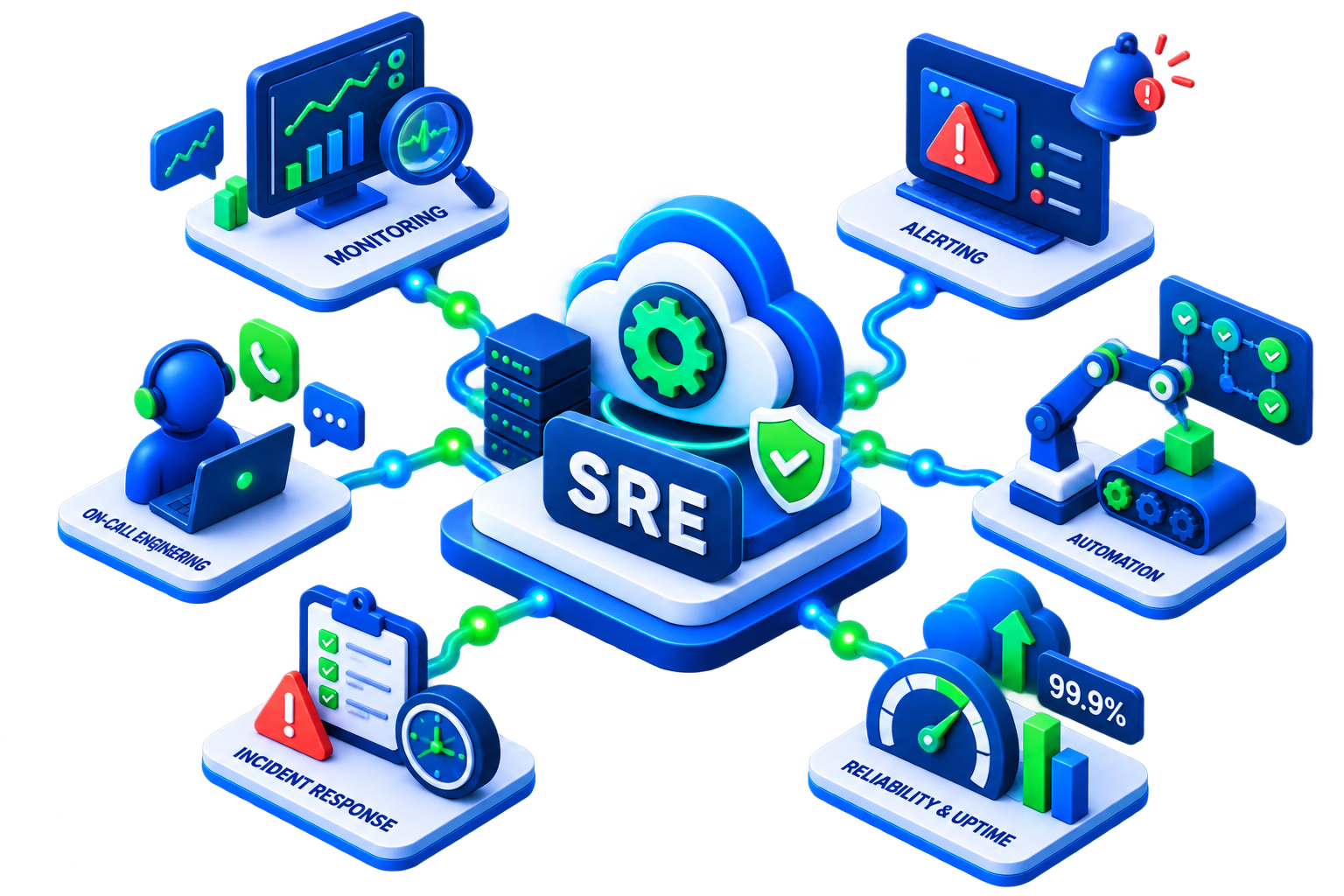
Find the Right SRE Support for Your Team
Start with the reliability fundamentals for one critical service, expand SRE practices across multiple services, or build a tailored engagement around your specific reliability requirements.
We need to establish SRE practices for a critical service.
You are experiencing reliability challenges and need a practical foundation for measuring service reliability, improving incident response, and establishing consistent operational practices.
We need to extend SRE across multiple critical services.
You have established reliability practices or multiple critical services and want to strengthen incident response, introduce error budgets, and improve operational readiness.
Our reliability needs go beyond a standard engagement.
You have a larger or more complex environment that requires a tailored SRE adoption plan based on your services, reliability goals, existing processes, and tooling.
✦ PRICING
Choose the Right Level of SRE Support
Start with the fundamentals for one critical service or extend SRE practices across multiple services with deeper training, operational controls, and failure simulations.
Foundation
Establish the core SRE practices needed to improve reliability around one critical application or service.
$8,000 USD One-time SRE adoption engagement
- 1 critical application or service
- 4 planning sessions with the development team
- Define and implement up to 3 SLIs and corresponding SLOs
- Establish a basic on-call and incident response workflow
- Monitoring and alerting for defined SLOs using existing tools
Accelerator
Expand SRE practices across multiple critical services with deeper training, operational controls, and failure simulation.
$15,000 USD One-time SRE adoption engagement
- Everything included in Foundations
- Up to 3 critical services
- 6 planning and training sessions
- Define and implement up to 7 SLIs and corresponding SLOs
- Refine the incident process and establish error budgets
- Conduct a Game Day failure simulation
- Introduce and configure 1 new tool
GET STARTED
Let's Discuss Your SRE Requirements
Tell us a little about your team and we'll get in touch to discuss the right SRE adoption engagement for you.
ENQUIRY RECEIVED
Thanks! We've received your enquiry.
Your SRE requirements have been submitted successfully. Our team will review your details and get in touch with you shortly.
SUBMISSION ERROR
We couldn't submit your enquiry.
Something went wrong while submitting your details. Please try again. If the problem continues, you can contact our team directly.
Make Reliability a Business Priority
SRE practices give engineering teams a structured way to measure reliability, respond to incidents, and manage operational risk while keeping development priorities in focus.
Reduce Incident Impact
Establish clear on-call and incident response processes so teams can respond to reliability issues consistently and reduce disruption to critical services.
Set Clear Reliability Targets
Use SLIs and SLOs to turn reliability into measurable targets that engineering teams can track, understand, and act on.
Manage Operational Risk
Use error budgets to create a practical framework for balancing reliability with release velocity and deciding when reliability needs greater attention.
Improve Engineering Readiness
Planning, training, and Game Day exercises help teams prepare for failure scenarios and strengthen their response before a major incident occurs.
Make Reliability Visible
Monitoring and alerting tied to defined SLOs give teams better visibility into service health and whether reliability targets are being met.
Build SRE Capability
Equip development teams with practical SRE practices they can continue applying across their services after the engagement ends.
From Reliability Gaps to Operational Readiness
We help your engineering team move from identifying reliability gaps to implementing measurable SRE practices, with each stage aligned to your critical services and operational needs.
Assess
We review your critical services, reliability challenges, existing monitoring, incident processes, and operational gaps.
Define
We identify relevant SLIs, establish SLOs, and define measurable reliability targets for your critical services.
Implement
We establish on-call and incident response workflows and configure monitoring and alerting using your existing tools.
Validate
We refine reliability practices, establish error budgets, and conduct a Game Day simulation where included.
Not Sure Where to Start?
Book a call with our cloud and DevOps team.
We’ll discuss your current setup, challenges, and goals, and help you determine the right next step.
Frequently Asked Questions
Direct answers to the questions teams ask before adopting Site Reliability Engineering practices with CDOps Tech.
What is SRE Adoption?
SRE Adoption is a structured engagement that helps established startups introduce practical Site Reliability Engineering practices into their engineering workflows. Depending on the engagement, this can include defining SLIs and SLOs, improving incident response, establishing error budgets, configuring monitoring and alerting, and training development teams.
Who is SRE Adoption for?
SRE Adoption is designed for established startups experiencing reliability issues with critical applications or services and looking to introduce SRE practices into their existing engineering processes.
What's the difference between Foundations and Accelerator?
Foundations is designed for one critical application or service and includes 4 planning sessions, up to 3 SLIs and SLOs, a basic on-call and incident response workflow, and monitoring and alerting using existing tools. Accelerator supports up to 3 critical services and includes 6 planning and training sessions, up to 7 SLIs and SLOs, refined incident processes, error budgets, a Game Day failure simulation, and configuration of one new tool.
Do we need an existing SRE team to get started?
No. The engagement is designed to help development teams adopt SRE practices as part of their existing workflows. Foundations can provide a starting point for teams that are beginning their SRE journey.
What are SLIs and SLOs, and will you help us define them?
Yes. Defining and implementing SLIs and corresponding SLOs is a core part of the engagement. Foundations includes up to 3 SLIs and SLOs, while Accelerator includes up to 7.
Will you work with our existing monitoring and alerting tools?
Yes. Monitoring and alerting for defined SLOs are set up using your existing tools. The Accelerator package also includes the introduction and configuration of one new tool where required, such as an on-call management or status-page tool.
What is a Game Day failure simulation?
A Game Day is a controlled failure simulation used to test how your team responds to reliability incidents. It helps teams identify gaps in incident response, communication, operational processes, and system readiness before a real incident occurs.
What are error budgets?
Error budgets provide a way to balance reliability and development velocity using the SLOs established for a service. They help teams make informed decisions about when to prioritize reliability work and when to continue shipping new changes.
How long does an SRE Adoption engagement take?
The timeline depends on the number of services, existing tooling, team availability, and implementation requirements. The engagement is structured around planning, implementation, and team training, with the specific timeline established based on your environment and selected package.
Can the SRE engagement be customized?
Yes. While Foundations and Accelerator provide defined scopes, the engagement can be tailored for teams with more complex environments, additional services, or specific reliability requirements that fall outside the standard packages.
What does SRE Adoption cost?
The Foundations package starts at $8,000, while the Accelerator package starts at $15,000. Final pricing depends on the scope of services, existing tooling, reliability requirements, and implementation needs.
How much time does our engineering team need to commit during the engagement?
We design the adoption process to minimize disruption to your active product sprints. Your Engineering Lead or service owner typically commits 2 to 3 hours per week for alignment, SLO definition, and review sessions. CDOps Tech handles the heavy lifting on research, dashboard setup, and alert configuration.
Is this engagement purely advisory, or do you perform hands-on configuration?
It is a collaborative, hands-on implementation. We don't just deliver strategy documents—our engineers directly build your monitoring dashboards, configure alert routing, set up error budget triggers, and draft incident runbooks within your environment.
Will implementing SRE practices and Error Budgets slow down our feature releases?
No. The primary goal of Error Budgets is to give your team a data-driven framework to ship software faster with confidence. By defining explicit reliability boundaries, your engineering team reduces emergency fire-fighting, freeing up sprint capacity for core feature development.
What cloud platforms and monitoring stacks do you support?
We work natively across major cloud providers (AWS, GCP, Azure) and modern observability platforms, including Datadog, Grafana, Prometheus, AWS CloudWatch, New Relic, PagerDuty, Opsgenie, and Better Stack. We adapt entirely to your existing infrastructure.
How do you access our environment, and how is sensitive data protected?
Access is strictly governed by the Principle of Least Privilege using client-managed SSO credentials, temporary IAM roles, or short-lived VPN access. We never copy, extract, or store production data outside your approved environment, and all access is revoked upon project completion.
What happens after the engagement ends? Is ongoing support available?
At project conclusion, we deliver complete operational runbooks, architecture documentation, and a recorded training session so your internal team can confidently manage the setup. If you require ongoing platform engineering bandwidth or advisory support, you can transition into a CDOps Tech retainer.
